

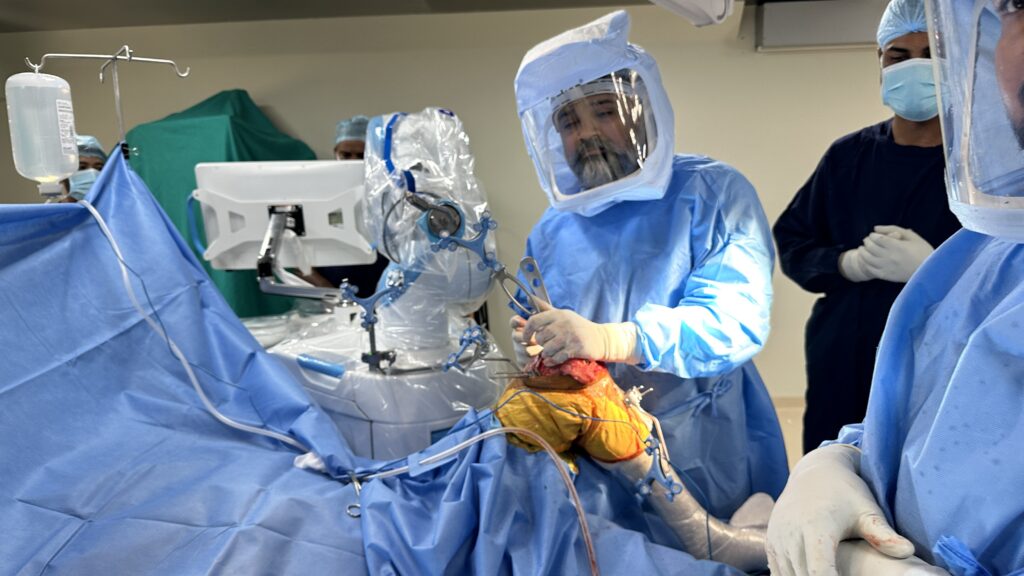
Robotic Joint Replacement: Benefits, Procedure & Recovery
Advances in orthopaedic technology have introduced new tools that can assist surgeons in planning and performing selected joint replacement procedures.
Robotic-assisted joint replacement is one such approach. It is important to understand that robotic technology does not replace the orthopaedic surgeon. Instead, the technology is used as a surgical aid, depending on the procedure and patient’s needs.
What Is Robotic-Assisted Joint Replacement?
Robotic-assisted joint replacement combines the expertise of an orthopaedic surgeon with computer-assisted planning and technology.
The process can involve detailed pre-operative planning and technology designed to assist with bone preparation and implant positioning.
Who May Be Considered?
Robotic-assisted joint replacement may be considered for selected patients who require joint replacement.
The suitability of the approach depends on:
- Diagnosis
- Joint damage
- Anatomy
- Overall health
- Surgical requirements
- Surgeon assessment
Not every patient requires robotic assistance.
Potential Advantages
Depending on the system and procedure, robotic technology may assist with:
- Detailed surgical planning
- Assessment of individual anatomy
- Bone preparation
- Implant positioning
- Surgical precision
These potential advantages should be discussed with the treating orthopaedic surgeon because outcomes depend on many factors, including the patient’s condition and the surgical technique used.
What Happens Before Surgery?
Before joint replacement, the surgeon evaluates the patient’s symptoms, medical history, physical condition and imaging.
The surgical plan is then developed based on the individual anatomy and treatment requirements.
Recovery After Robotic Joint Replacement
Robotic assistance does not eliminate the need for rehabilitation.
Following joint replacement, patients generally need to follow their surgeon’s instructions regarding walking, exercises, wound care and activity progression.
Rehabilitation can help restore joint movement and strength after surgery. OrthoInfo
Is Robotic Surgery Right for Everyone?
No single surgical technique is appropriate for every patient.
The decision should be based on the patient’s diagnosis, anatomy, overall health and the surgeon’s clinical assessment.
Conclusion
Robotic-assisted joint replacement represents one of the technological developments available in modern orthopaedic surgery.
The most important step remains choosing the right treatment for the individual patient.
Consult Dr. Sai Phani Chandra to understand whether robotic-assisted joint replacement may be appropriate for your condition.